Discovering Jura: a practical guide
Jura is a land of water: waterfalls, lakes and reculées (blind valleys) follow one another on forested plateaus. The département also has a distinctive vineyard, characterful villages and a strong craft tradition. It is a quiet, authentic nature destination.
This practical guide helps you choose your stops and organise your trip. Underlined site names link to their detailed pages.
Understanding Jura in a few minutes
Jura rises in three levels. To the west, the Revermont and the vineyards, around Arbois, Lons-le-Saunier and Château-Chalon, with the famous reculées. In the centre, the lake district, around the Lac de Chalain and the Lac de Vouglans, and the Hérisson waterfalls. To the east, the more mountainous Haut-Jura, around Saint-Claude and the Les Rousses resort.
Distances are modest, but mountain roads are slow. For a trip of a few days, a base in the lake district makes it easy to explore.
- The lake district is a central base.
- Haut-Jura roads can be snowy until spring.
- Trains link Dole and Lons-le-Saunier, but a car remains essential.

Arbois
Historic capital of the Jura vineyards where Louis Pasteur carried out his research on fermentation, crossed by the Cuisance and its picturesque Capucins bridge.

Lac de Chalain
This glacial lake nestled in a Jura reculée is among the largest natural lakes in France. Its shores have yielded the remains of a Neolithic lake village listed as a UNESCO World Heritage site.
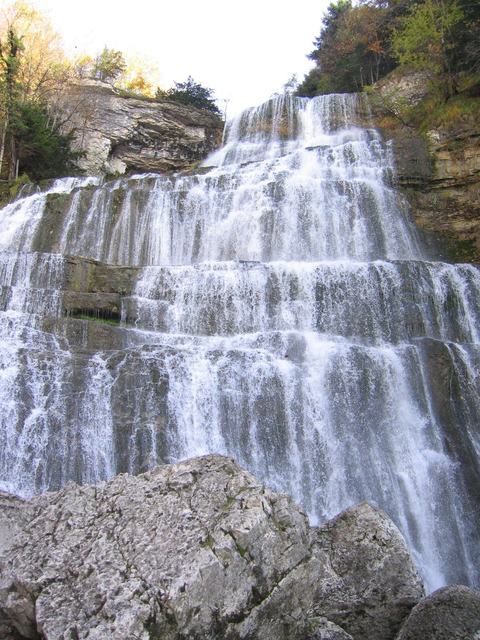
Cascades du Hérisson
The Hérisson Waterfalls, the Éventail and the Grand Saut: they are located near Doucier, in the heart of the lakes region.

Lons-le-Saunier
The main town of the Jura, born of salt springs worked since Antiquity, and birthplace of Rouget de Lisle, author of the Marseillaise.
Culture, history and heritage
Baume-les-Messieurs, at the bottom of its reculée, and Château-Chalon, perched on its spur, are two of the most beautiful villages in Jura. Castles recall the history of Franche-Comté: the Château Fort du Pin, the Château de Frontenay, the Château d'Arlay and the Château de Présilly. The ruined Château d'Oliferne offers a wide panorama.
Jura has a strong craft tradition. Saint-Claude is the capital of pipe-making, Moirans-en-Montagne that of toys, with the toy museum, and the Musée de la Boissellerie presents woodcraft. In Arbois, Louis Pasteur's house recalls the scientist's research. The Château de Syam is an astonishing Palladian villa.
- In Baume-les-Messieurs, park at the bottom of the village.
- Several castles open only in season: check.
- Children love the toy museum.

Baume-les-Messieurs
One of the French people's favourite villages lies in the typical reculées of the Jura foothills and in the heart of an exceptional site classified Natura 2000 and 3 stars.

Château-Chalon
Famous for its former abbey and its wines, this small village perched on top of a rocky spur has kept the ruins of a fortress built in the Middle Ages to protect a Benedictine nuns' abbey founded on the spot as early as the sixth century.

Château Fort du Pin
In the struggle between the Chalon and Vienne families for control of the Lons-le-Saunier area, Jean de Chalon built a fortress in 1253.

Musée du jouet
In France's toy capital, discover a selection of 2,000 toys from the nineteenth century to today, from a collection of 10,000 pieces. One temporary exhibition a year, an audiovisual room, shop, play areas, accommodation.
Food and local produce
Jura is the home of Comté, the most widely eaten PDO cheese in France, as well as Morbier and Bleu de Gex. The neighbouring Morteau sausage and chicken with vin jaune and morels are signature dishes.
The Jura vineyard produces unique wines: vin jaune, aged six years under a veil of yeast, vin de paille (straw wine), Crémant du Jura and Macvin. The Percée du Vin Jaune, the vineyard festival, takes place every year in early February in a different village.
- Visit a fruitière (cheese dairy) to see how Comté is made.
- Try vin jaune with a well-aged Comté.
- For the cellars, nominate a driver.
Arbois
Historic capital of the Jura vineyards where Louis Pasteur carried out his research on fermentation, crossed by the Cuisance and its picturesque Capucins bridge.
Château-Chalon
Famous for its former abbey and its wines, this small village perched on top of a rocky spur has kept the ruins of a fortress built in the Middle Ages to protect a Benedictine nuns' abbey founded on the spot as early as the sixth century.

Château d'Arlay
A former convent of the Minim order, the U-shaped central building was bought by Elisabeth-Pauline de Gand, Countess of Lauraguais, heiress to the fortress of the Princes of Orange on the hill above the present château.
Nature and wide open spaces
The Hérisson waterfalls are Jura's most famous site, with a series of falls along a forest path. The Baume-les-Messieurs waterfall, the Cascade de la Queue de Cheval near Saint-Claude and the Billaude waterfall are other fine falls. Gorges are plentiful: the Cirque et Gorges de Flumen, the Langouette gorges and the Abîme gorges.
The Lac de Chalain and the Lac de Vouglans are good for swimming and water sports. The source of the Ain and the Saut de la Saisse complete the visit. The Haut-Jura regional nature park offers hiking in summer and cross-country skiing in winter, with the spectacular road of the Chapeau de Gendarme. The Grotte des Moidons can be visited near Arbois.
- At the Hérisson waterfalls, the full path takes about three hours there and back.
- The waterfalls are at their best in spring, after the snowmelt.
- Wear good shoes: the paths are slippery.
Cascades du Hérisson
The Hérisson Waterfalls, the Éventail and the Grand Saut: they are located near Doucier, in the heart of the lakes region.

Cascade de la Queue de Cheval
The Queue de Cheval waterfall: accessible on foot from Saint-Claude, it has a 60 m fall in two leaps in a charming site. See also the Queue de l'Âne waterfall.
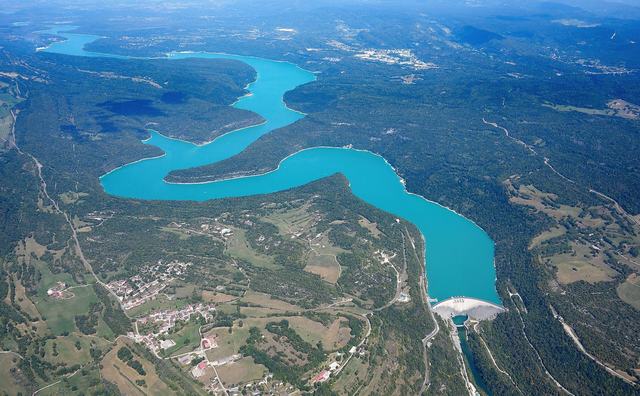
Lac de Vouglans
Created by the filling of the Ain dam in 1968, Lac de Vouglans winds over several kilometres between wooded Jura shores. The third largest artificial lake in France, it has become a flagship water-sports destination.
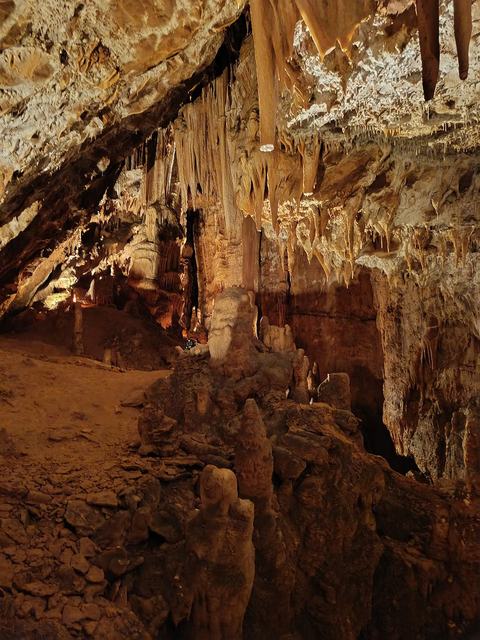
Grotte des Moidons
Ten minutes from Arbois (Jura), discover a real masterpiece of nature.
When to go and how to plan
Spring is ideal for the waterfalls, which are in full flow. Summer is pleasant for the lakes and hiking. Autumn colours the forests. In winter, the Haut-Jura is a major cross-country skiing destination.
A four-day trip can combine a day in the vineyards (Arbois, Château-Chalon, Baume-les-Messieurs), two days in the lake and waterfall district, and a day in the Haut-Jura.
- Book accommodation near the lakes in summer.
- Some Haut-Jura roads require winter equipment.
- Check cave opening times out of season.

Saut de la Saisse
A fall of the Ain at the entrance of Lac de Vouglans, with its giants' kettles carved in the limestone.

Château de Frontenay
Built on a spur to protect salt convoys, a precious commodity since the early Middle Ages, Frontenay has come through the centuries with its twelfth-century vaulted rooms and fourteenth-century keep.

Parc naturel régional du Haut Jura
The Haut-Jura regional nature park was created on 10 February 1986 and then grouped thirty-seven communes.
Going further
Explore the départements of this area: