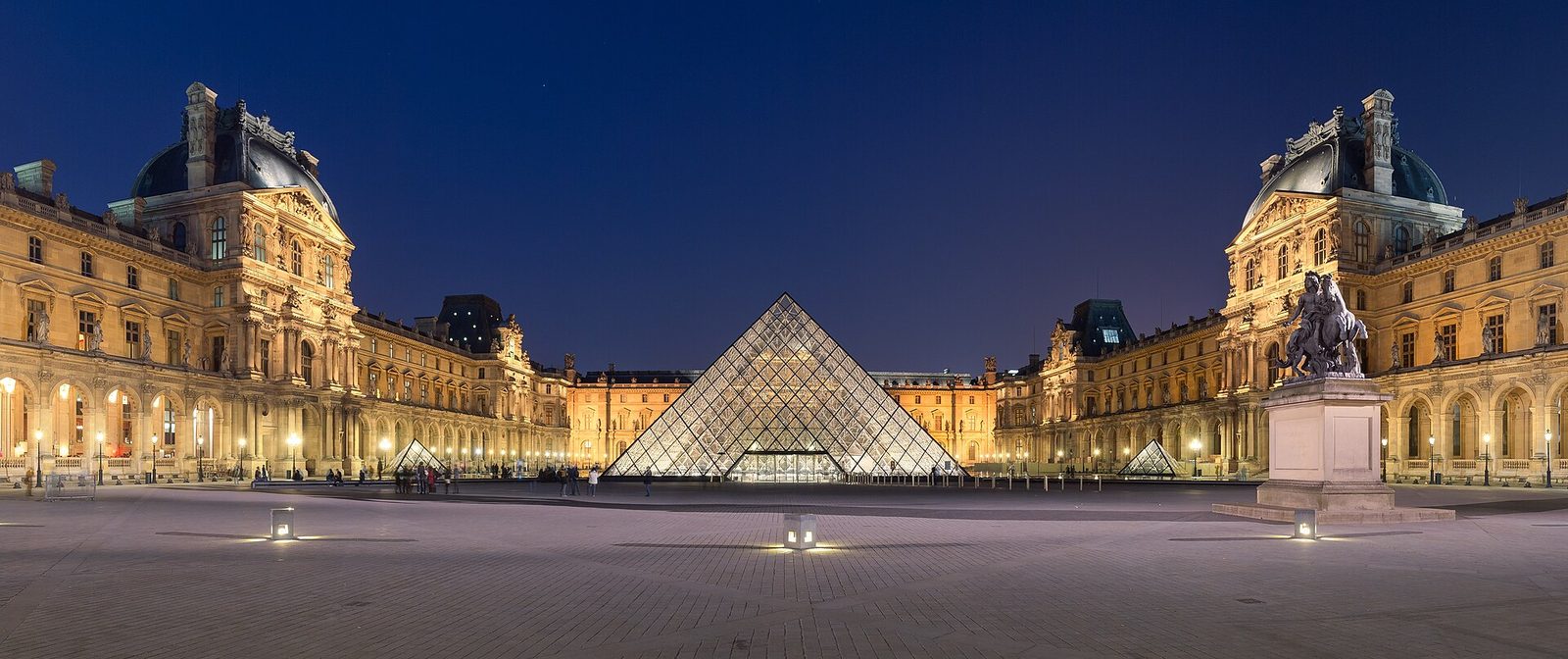
Photo : Benh LIEU SONG (Flickr) / Wikimedia Commons (CC BY-SA 3.0)
Le musée du Louvre
The Louvre, in the 1st arrondissement of Paris, is one of the largest art museums in the world. It occupies a former royal palace whose origin is a fortress built by Philip Augustus around 1190. Francis I turned it into a Renaissance palace in the sixteenth century and formed the first royal picture collection there. The collections grew greatly in the seventeenth century, notably thanks to acquisitions made under Louis XIV with Colbert.
The museum opened in August 1793, during the Revolution, to present the masterpieces of the Crown to the public. It now holds more than 500,000 works, of which about 36,000 are on show over 72,735 m² of galleries. They are divided into nine departments, from Oriental and Egyptian antiquities to sculptures, paintings and decorative arts, from Antiquity to 1848.
Among the best-known pieces are Leonardo da Vinci's Mona Lisa, the Winged Victory of Samothrace and the Venus de Milo. The glass pyramid by Ieoh Ming Pei, inaugurated in 1989, adapted the museum's reception to a mass public.


