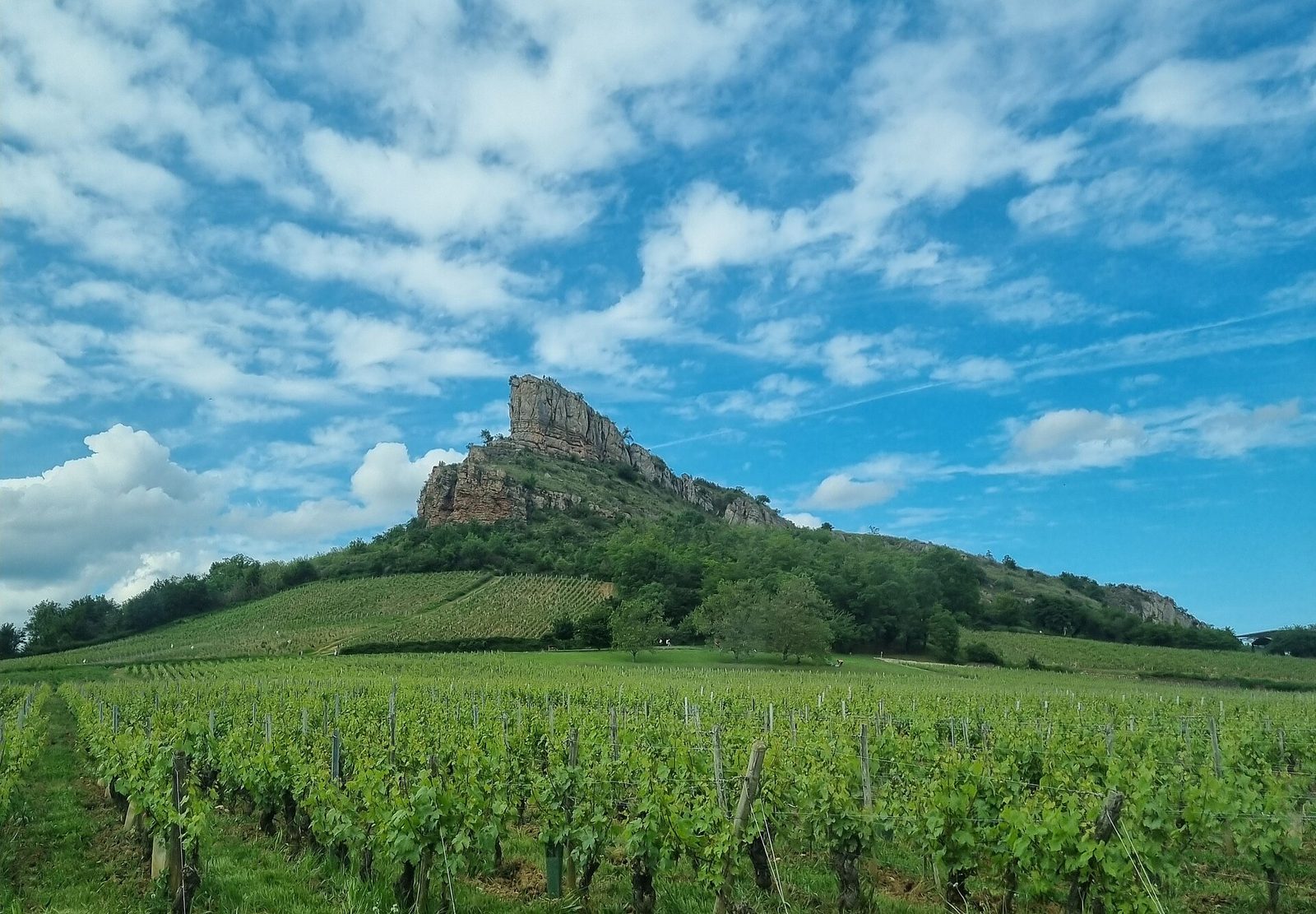
Photo : LSL36 / Wikimedia Commons (CC0)
La Roche de Solutré
About ten kilometres west of Mâcon, in Saône-et-Loire, the Roche de Solutré is a limestone escarpment rising to 493 metres, overlooking the vineyards of the Mâconnais. It formed from coral reefs about 160 million years old, brought to light by the uplift of the Alps and the subsidence of the Saône basin.
The place is also one of Europe's great prehistoric sites. Excavations launched in 1866 by Henry Testot-Ferry and Adrien Arcelin yielded countless stone tools and animal bones, evidence of human presence over more than 50,000 years. It gave its name to an Upper Palaeolithic culture, the Solutrean. The legend of horses driven off the cliff top actually comes from a novel by Arcelin published in 1872, and no scientific evidence confirms it.
A path leads to the summit, from where you see the Pouilly-Fuissé vineyard. The high-altitude grasslands, protected under Natura 2000, shelter rare species. The prehistory museum, opened in 1987, completes the visit. The site has carried the Grand Site de France label since 2013.