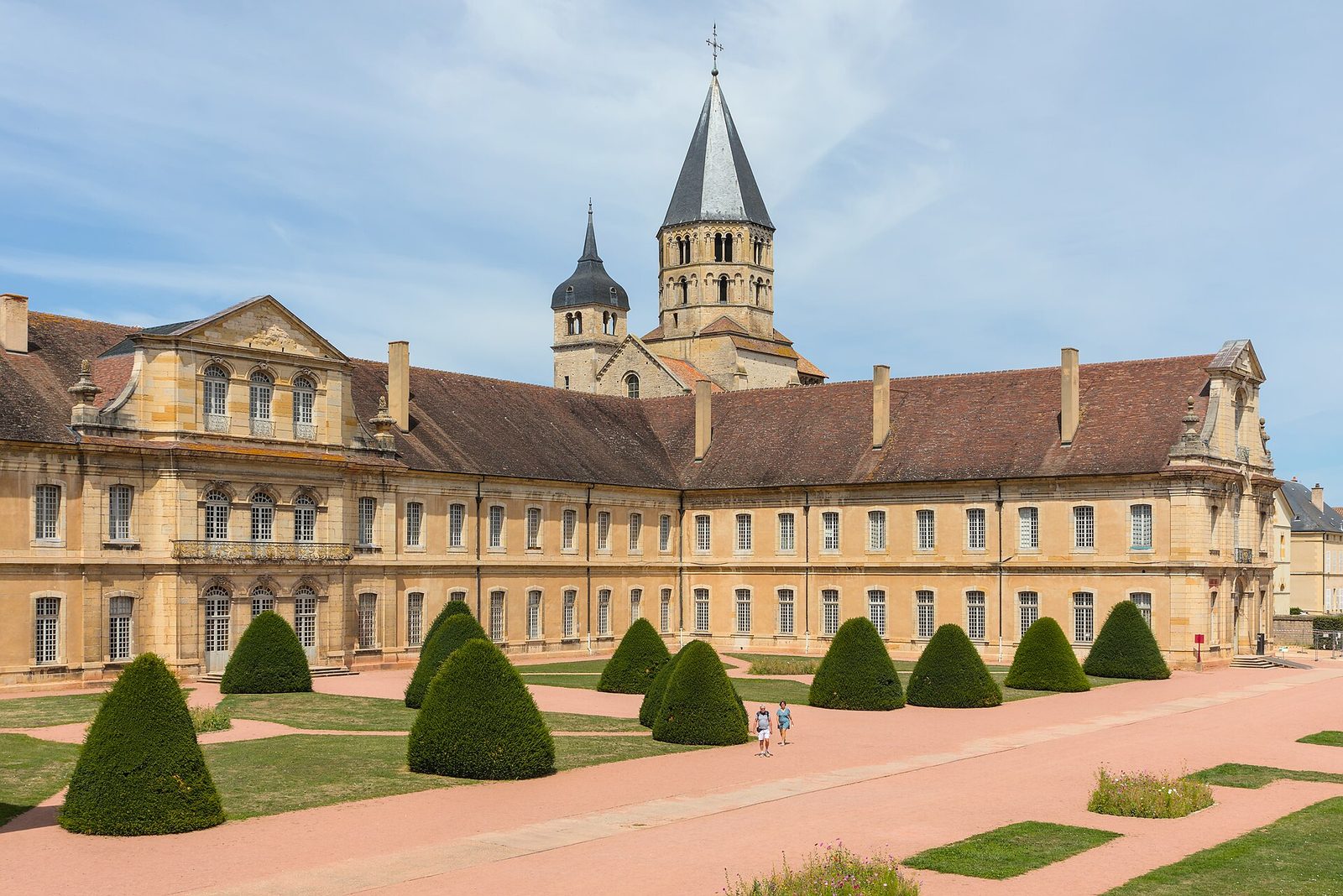
Photo : Benjamin Smith / Wikimedia Commons (CC BY-SA 4.0)
L'Abbaye de Cluny
Cluny Abbey, founded in 910, developed very quickly, led by its illustrious abbots. The Cluniac order took shape with the foundation and reform of several abbeys in France and further afield, reduced to the rank of priory or deanery and depending directly on the mother abbey of Cluny.
At its height, the abbey ruled some 1,500 monasteries throughout Europe. After the destruction of the 18th and 19th centuries, only a few buildings and part of its third abbey church remain of the marvellous ensemble, built by the illustrious Abbot Saint Hugh between 1088 and 1130, to replace a pre-Romanesque 10th-century church that was already very important (Cluny II).
This third building, known as Cluny III, was the largest church in the world until the construction of St Peter's in Rome. The church consisted of a great nave of 11 bays with double aisles, two transepts crowned by 4 bell towers, and a choir with ambulatory and radiating chapels.
This majestic ensemble was completed in the 12th century by the construction of the two-towered narthex façade, in which stood the great west portal with its famous sculpted tympanum.
Of the splendid abbey church, only a minor part remains today: the south arm of the great transept and its very fine bell tower known as the Holy Water tower, the remains of the south arm of the small transept, a few ruins of the narthex and the lower floors of its two towers.
The surviving transept arm shows the power of the abbey church's architecture: a three-storey elevation under pointed barrel vaults at an unusual height.