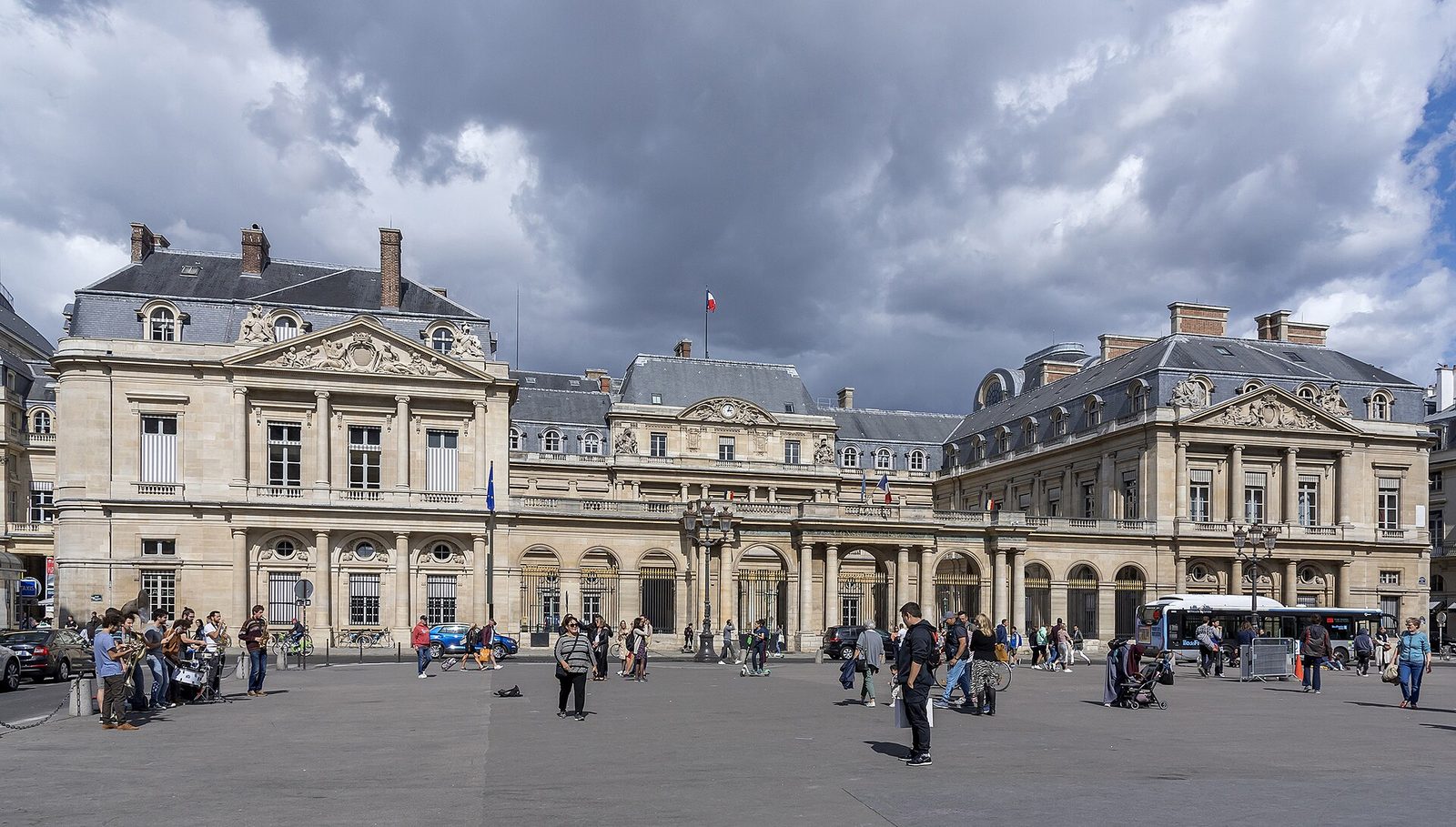
Photo : Alexandre Prevot from Nancy, France / Wikimedia Commons (CC BY-SA 2.0)
Palais-Royal
A stone's throw from the Louvre, the Palais-Royal was built at the request of Cardinal Richelieu in 1633. Bequeathed to the Crown from 1636, the Palace became a royal residence. At the end of the eighteenth century, Louis-Philippe d'Orléans enlarged it by having houses with uniform façades built on three sides of a large garden. The ground-floor galleries communicate with the Palais-Royal garden through arcades and host shops and cafés. Composed of rows of limes trimmed in awning shape and red horse chestnuts, the garden is enhanced by a central fountain whose jets spread towards two long lawns bordered by flower beds, redesigned by the landscape designer Mark Rudkin. Many marble statues ("The Snake Charmer" (1875) by Adolphe Thabard, "The Shepherd and the Goat" (1830) by Paul Lemoyne...) line the paths. Since 1986, the palace's court of honour has hosted a 3,000 m² sculpture by Daniel Buren. Titled "Les Deux Plateaux", this work is made of black and white marble columns lit at night by a green fluorescent light. The garden is surrounded by several buildings of the Republic: the Conseil d'État, the Conseil constitutionnel and the Ministry of Culture. It also borders the Comédie-Française and the Bibliothèque nationale de France. Since its creation in 1997, the association Sculptures au Palais-Royal has held temporary sculpture exhibitions in the garden.


