Photo : Norbert Aepli, Switzerland (User:Noebu) / Wikimedia Commons (Public domain)
Château de Montbéliard
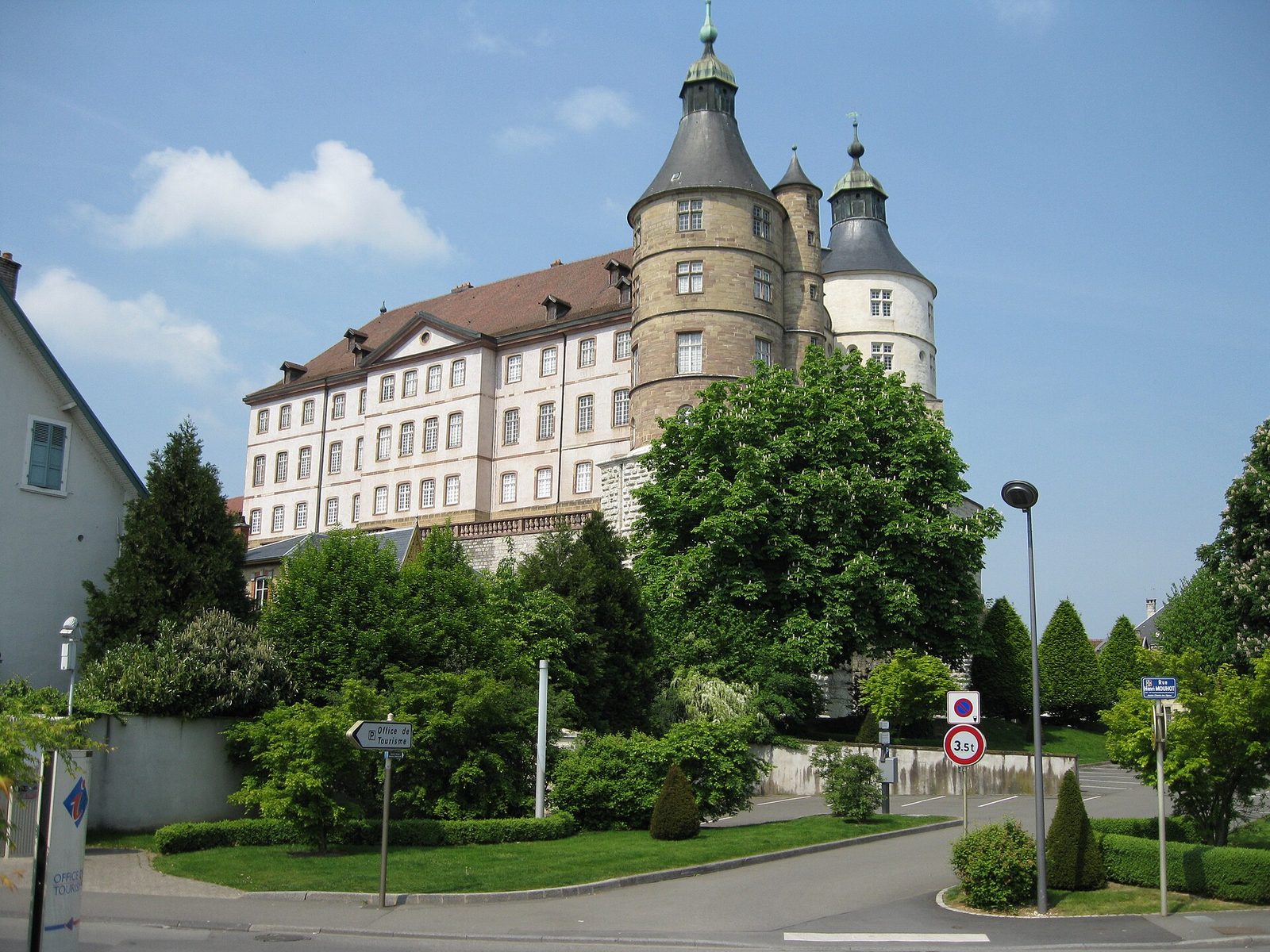
The château de Montbéliard (also called the Château des ducs de Wurtemberg) dates from the thirteenth century. It is on a rock ridge overlooking the centre of Montbéliard.
In 1793, the château was attached to the Kingdom of France as a garrison, a role it fulfilled until 1933. Formerly, the château was divided into two parts relative to the church of Saint-Maimbœuf (very old) built on the esplanade and which, at 44 metres, dominated the whole town.
The Châtel-Derrière, to the east, with its two imposing towers, housed (at all times) the reception rooms and private apartments of the counts and dukes who succeeded one another in the County, then in the Principality. This part of the castle was separated by a vast and deep ditch, now vanished, crossed by a drawbridge.
The Châtel-Devant, to the west, which overlooks the Allan and the Lizaine (before it was channelled underground), had along its north face the fortress's only entrance (still present in the same place) which had its drawbridge and portcullis. There was also a ditch that added to the entrance's protection and disappeared during major works in the eighteenth century. The Châtel-Devant held within its enclosure the garrison buildings, in which prominent passing persons were sometimes lodged. There were also the stables, the falconry and the arsenal where cannons, ammunition and weapons needed for the defence of the castle and the town were stored.
Finally, the Hôtel du Bailli (or gentlemen's mansion) still overlooks with its imposing mass this part of the castle. One can also mention the chancellery building that stood immediately at the castle entrance. What is known is that the castle was in an advanced state of disrepair at the end of the eighteenth century. So, several buildings were demolished and rebuilt. Two major transformations in the nineteenth century changed the castle's appearance: first, the disappearance of the church of Saint-Maimbœuf in 1810, then the destruction in 1880 of the house known as "between the towers", a building flanked between the Henriette and Frédéric towers that so characterise the Châtel-Derrière and give the castle this imposing look to tourists as soon as they reach the town. The "between the towers" house was replaced by a façade adorned with scrolls made in the pure style of the seventeenth-century Germanic period.